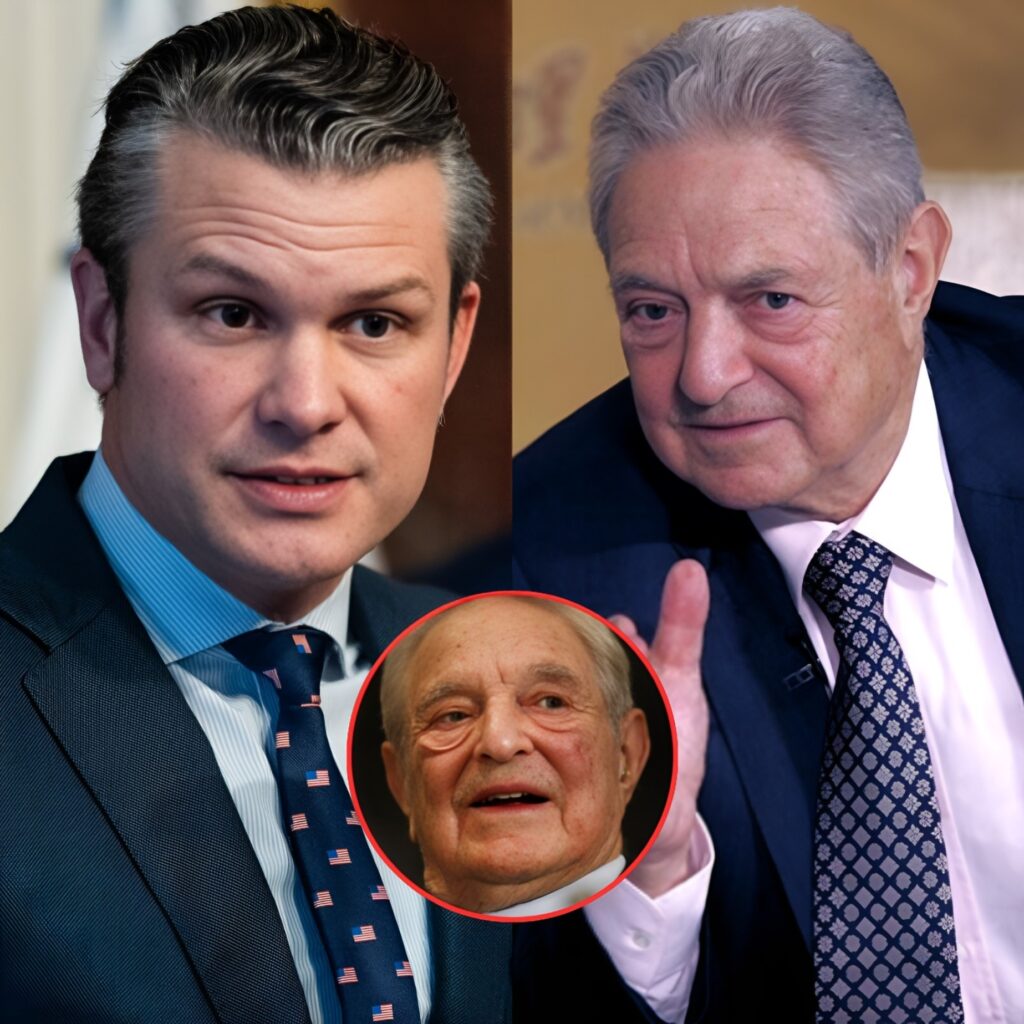
The atmosphere on Capitol Hill shattered the moment the announcement broke. Phones erupted with alerts, the frantic tapping of keyboards echoed down hallways, and stunned staffers abandoned their half-eaten lunches. Within minutes, social media became a maelstrom of chaotic information as news flashed across the screens: Representative Pete Hegseth had just introduced what is being called the most aggressive, sweeping piece of legislation of the decade—a direct, frontal strike aimed at blocking George Soros from allegedly secretly bankrolling widespread protests across the United States.
What Hegseth unveiled was anything but a symbolic measure or a piece of performative politics. It was a fully loaded legislative strike, drafted with the surgical precision of an intelligence operation and aimed squarely at the sprawling financial networks that, in his view, have been “fueling nationwide unrest under the guise of grassroots activism.”
Standing before a press room packed to capacity, Hegseth solemnly laid a heavy, dark-blue binder onto the podium. Stamped clearly on the cover was the official title: “The Domestic Integrity and Anti-Covert Funding Act.” He then delivered the line that instantly sent the story into the political stratosphere:
“If you are funding chaos in this country from the shadows, you are not an activist—you are a criminal.”
The RICO Hammer: Defining Covert Funding as Organized Crime
According to high-level Capitol Hill insiders, the bill is engineered to dramatically reclassify the covert financing of protests, riots, or any form of organized public disruption as potential organized crime under the powerful Racketeer Influenced and Corrupt Organizations (RICO) Act. This is a designation historically reserved for the most serious illegal enterprises, including mafia rings, international drug cartels, and major financial conspiracies.
Under the audacious terms of Hegseth’s proposal, any foreign-backed foundation, non-governmental organization (NGO), or affiliated entity found to be funnelling money into street movements could face the immediate and sudden freezing of its accounts. Not after months of protracted court battles, but
instantly.
The press room immediately erupted in a cascade of shouted questions, yet Hegseth stood resolute. He began pulling documents directly from his binder: complex financial maps, detailed transaction chains, cross-border wire patterns, and an annotated list of shell organizations allegedly tied directly to Soros-linked groups. Crucially, the evidence he presented was not speculative; each chart was meticulously timestamped, coded, and connected to specific financial conduits.
“These networks operate quietly,” Hegseth asserted, his voice cutting through the noise, “but their impact is loud. Loud in our streets. Loud in our cities. Loud in our communities. This bill is the first step toward turning down that volume.”
The Inevitable Backlash and Counter-Proof
The pushback was instantaneous and severe. Activist groups swiftly issued furious statements within minutes, denouncing the bill as “dangerous,” “authoritarian,” and a direct “threat to civil liberties.”
However, Hegseth’s office was fully prepared for the swift backlash. They released a second set of damaging documents late that afternoon—additional financial tracings that reportedly connected sudden, significant spikes in funding to specific periods of violent civil unrest. The synchronized timing, the amounts transferred, and the international sources, his team argued, lined up too cleanly to be dismissed as coincidence.
A high-level official, who was granted an early review of the draft legislation, quietly commented, “If even half of this holds up in court, it’s going to change the rules of the game forever.”
Meanwhile, political commentators across the entire spectrum scrambled onto live broadcasts. Those on the left accused Hegseth of overtly targeting legitimate political opponents. Those on the right argued that foreign financial influence had crossed critical red lines for too long. One veteran analyst remarked, “Whether you agree with his politics or not, this is without a doubt the most significant legislative challenge to Soros-backed financial networks we have ever witnessed.”

Behind the Scenes: Unease and Electrification
Behind the closed doors of Congressional offices, aides described the mood as simultaneously “electrified” and “uneasy.” Some lawmakers expressed deep concern about how broadly the bill’s definition of “covert funding” might be interpreted. Others were reportedly thrilled, arguing that Soros-linked entities have been permitted to operate in a “legal fog for decades.”
One senior advisor with years of policy experience summarized the mood: “This isn’t about stopping protests. It’s about stopping massive money laundering masquerading as activism.”
Hegseth, for his part, appears entirely unfazed by the growing firestorm. A source close to the Representative revealed that he has been methodically working on this detailed bill for months, gathering corroborated testimony from whistleblowers, field agents, and foreign analysts who specialize in tracking global destabilization patterns. The same source disclosed that a highly classified briefing, attended by only a handful of top intelligence officials, played a significant role in motivating Hegseth to move with such speed and intensity. “Something in that briefing definitively changed the tone,” the source stated. “After it ended, Pete walked out of the room and said, ‘We’re done playing defense.’”
As the bill formally hit the floor, early estimates suggested it had already garnered enough preliminary support to trigger mandatory committee hearings. That realization alone sent shockwaves through major financial and philanthropic circles. Several foundations were observed quietly scrubbing or removing public grant records from their official websites within hours. A number of prominent legal teams went into immediate, emergency meetings. Furthermore, social media accounts associated with protest mobilization groups began posting cryptic, anxious messages referencing “timing” and “unexpected pressure.” The digital landscape quickly became an anxious, bustling hive of activity.
Amidst the growing chaos, Hegseth made a second televised appearance, this time on the steps of the Capitol, intentionally flanked by a group of veterans who voiced unwavering support for the bill. One veteran delivered the soundbite of the day:
“You don’t get to tear down our communities with foreign money and call it activism. That ends today.” The line instantly went viral.
By nightfall, the hashtag #SorosShield trended across multiple digital platforms, with supporters framing the legislation as a vital national security milestone. Critics, conversely, issued dire warnings that the bill could rapidly spiral into an unprecedented expansion of government power over legitimate protest movements. The debate grew louder, faster, and exponentially more polarized, but even opponents could not deny the impact. This was not a symbolic gesture; it was a legislative grenade thrown directly into the center of America’s most sensitive political battlefield.
Through it all, Hegseth remained the unwavering eye of the storm—calm, deliberate, and fiercely focused. “We are not criminalizing protest,” he reiterated in a late-night interview. “We are criminalizing foreign-funded destabilization. There is a difference. A big one.”
Insiders confidently assert that this is only the beginning. Subpoenas are widely expected. Committee hearings promise to be explosive. Financial audits could potentially uncover even deeper, more complex networks. And if the bill manages to gather sufficient bipartisan momentum—which some analysts now believe is a distinct possibility—the United States could be on the precipice of a sweeping policy shift that fundamentally redefines the fraught boundaries between grassroots activism, foreign influence, and potential domestic subversion.
For now, one thing remains undeniably certain: Pete Hegseth did not merely introduce a piece of legislation. He intentionally kicked off a political earthquake. And the significant aftershocks are only just beginning to be felt.
